Part 2: Transformers capture the fine details of local cortical circuitry
Yash Shah
Nov 20, 2026
In Part 1, I showed that transformers are not so different from CNNs. Both develop hierarchical, retinotopic representations and rely primarily on local interactions. Transformers, however, also develop sparse long-range lateral connections. Can these connections help transformers better capture the fine details of cortical circuitry?
Both transformers and CNNs develop the right receptive fields at the population level. But what happens at the unit-level?
Neurons in primary visual cortex (V1) have relatively small classical receptive fields: regions of visual space where a stimulus directly drives their activity. Both CNNs and transformers develop similarly localized classical receptive fields.
But cortical neurons also respond to stimuli outside these regions. These broader extra-classical receptive fields, or surrounds, modulate a neuron’s response even when the surrounding stimulus does not drive it directly.
Transformers are the only model class that captures these extra-classical receptive fields, suggesting that their sparse, learnable lateral connections are important for reproducing this aspect of cortical function.

Beyond capturing unit-level computation, only transformers predict local iso-orientation specificity circuitry of lateral connections
If lateral connections help transformers develop extra-classical receptive fields, how are these connections themselves organized?
In monkey V1, lateral connections have been mapped by tracing the retrograde transport of biocytin from labeled boutons to their sites of origin. This reveals a patchy organization: connections link spatially separated groups of neurons with similar orientation preferences.
We performed our own virtual bouton-transport experiment in the models. Transformers were the only models to reproduce both the patchy organization and orientation specificity of cortical lateral connections. CNNs, which lack lateral connections, have no corresponding pattern of connection sites.
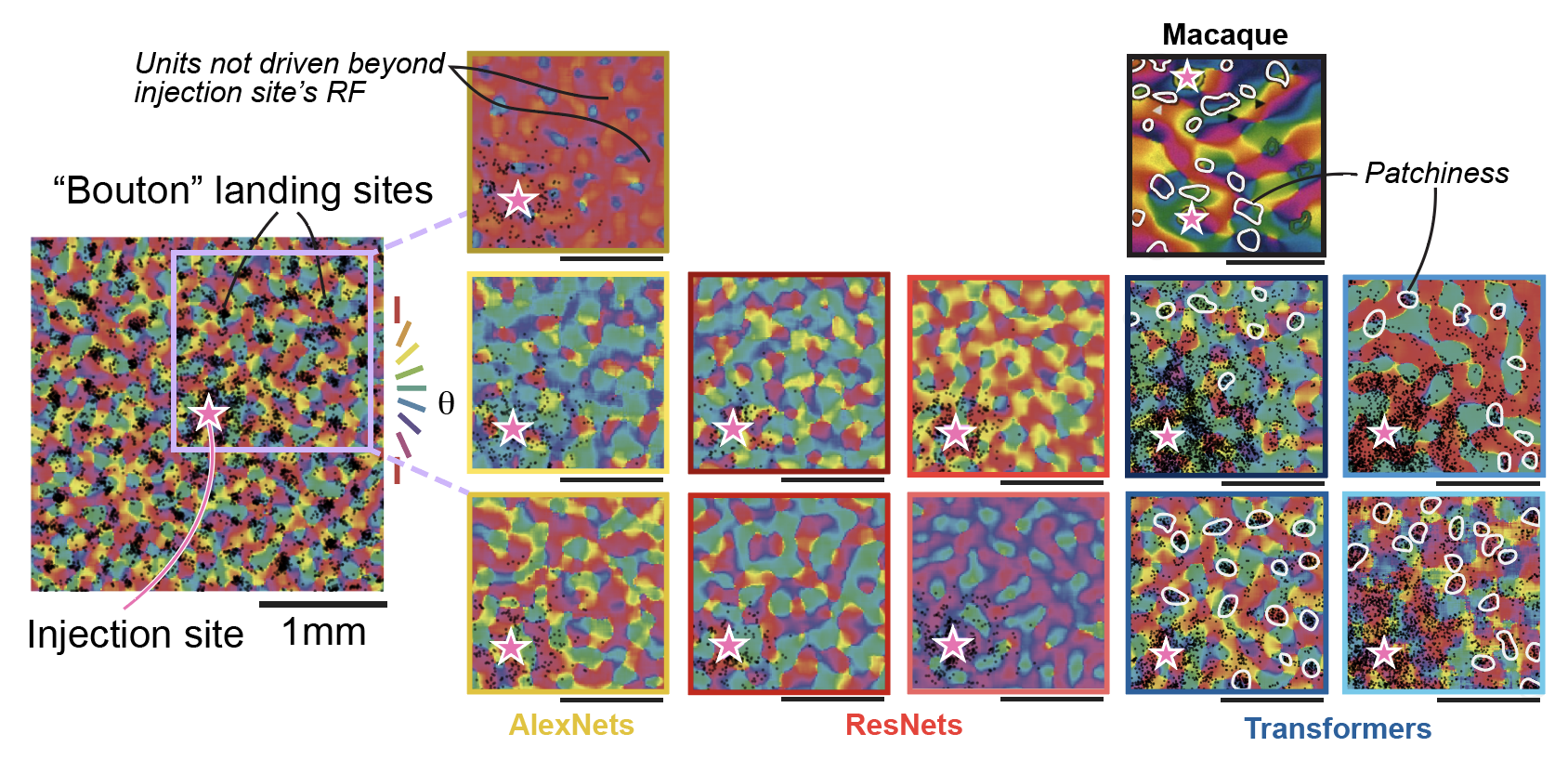
Transformers capture cortical circuitry down to the level of individual neurons
These results show that transformers capture fine-grained properties of how individual units compute and organize their connections.
In the next part, we’ll ask whether this correspondence extends beyond local circuitry to predicting large-scale, multi-area electrophysiology data.
Reach me by
email: ynshah [at] stanford [dot] edu
bluesky: @ynshah.bsky.social
linkedin: @ynshah3
x: @itsysxx